
Jesus shows us the way to care
8 March 2026 3rd Sunday Lent Year A
John 4:5-42
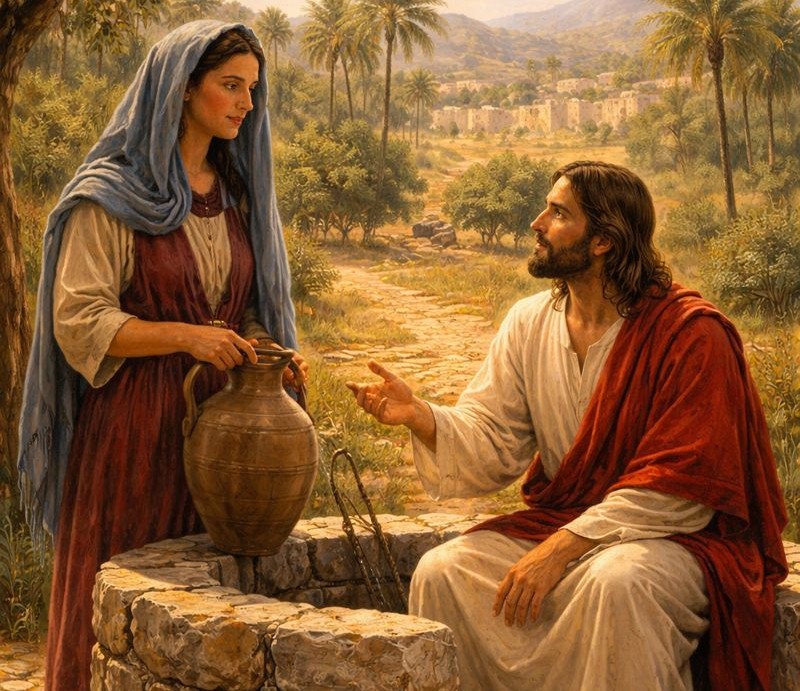
Breaking boundaries is not always a good thing! In fact, we do well, for the most part, to stay within the boundaries set by family, community, workplace, church and state.
However, if we are to grow in our calling to be missionary disciples of Jesus, we need to realise that Jesus himself was not afraid to question prejudices and break boundaries when the mission requires it.
This is precisely what happens in this week’s story of Jesus meeting the Samaritan woman at the well. First of all, as a rabbi or teacher, he was not supposed to enter into dialogue with a woman, certainly not on a one-to-one basis. Second, as a Jew, he was supposed to despise Samaritan people – in much the same ways as many Jews in the State of Israel despise Palestinian people today.
However, Jesus pays scant regard to such cultural and religious taboos by asking the Samaritan woman for water. We might say her reaction shows she was totally freaked out: “What, you a Jew, ask me a Samaritan for a drink?” She then becomes almost hostile and even sarcastic when Jesus suggests he could give her “living water”: “You have no bucket sir … are you greater than our father Jacob?”
Jesus again speaks of the water he is offering as quenching people’s thirst forever. Here Jesus breaks through the woman’s defences. Jesus then demonstrates he is fully aware of the woman’s irregular marriage situation – having had five husbands and now living with someone else! Yet, Jesus is not fazed by this, nor dismissive of the woman and her life-experiences.
To the contrary, Jesus draws the woman to pronounce him as a prophet as well as acknowledging something of her own faith in the God of Israel and the promised Messiah. Here is the only place in the ministry of Jesus where he identifies himself as the Messiah: “I who am speaking to you, I am he!”
The woman’s response is immediate. She takes off to inform the other people of the village she has met Christ the Messiah. Many came to believe, not just because of the strength of her testimony, but on account of their own experience of Jesus as “Saviour of the World”.
What we need to learn from this gospel story is that we are not called to be missionary disciples of Jesus on account of our own gifts or talents. The Samaritan woman was no paragon of virtue, yet Jesus, who knew everything about her, loved her and commissioned her to bring good news to others.
There is something else we can learn from the Samaritan woman, namely her honesty and straight-forward way of speaking. She does not pretend to be somebody other than who she is; yet, she is open to change her viewpoint and behaviour. She is also prepared to break boundaries by entering into dialogue with Jesus. Like the Samaritan woman, let us dialogue with Jesus and take his message of divine love and forgiveness to others.
Gerard Hall SM
© Majellan Media 2026
We encourage you to share and use this material on your own website. However, when using materials from Majellan Media, please include the following in your citation: Sourced from www.majellan.media