
Partaking in the living bread
7 June 2026 Body & Blood of Christ, Year A
John 6:51-58
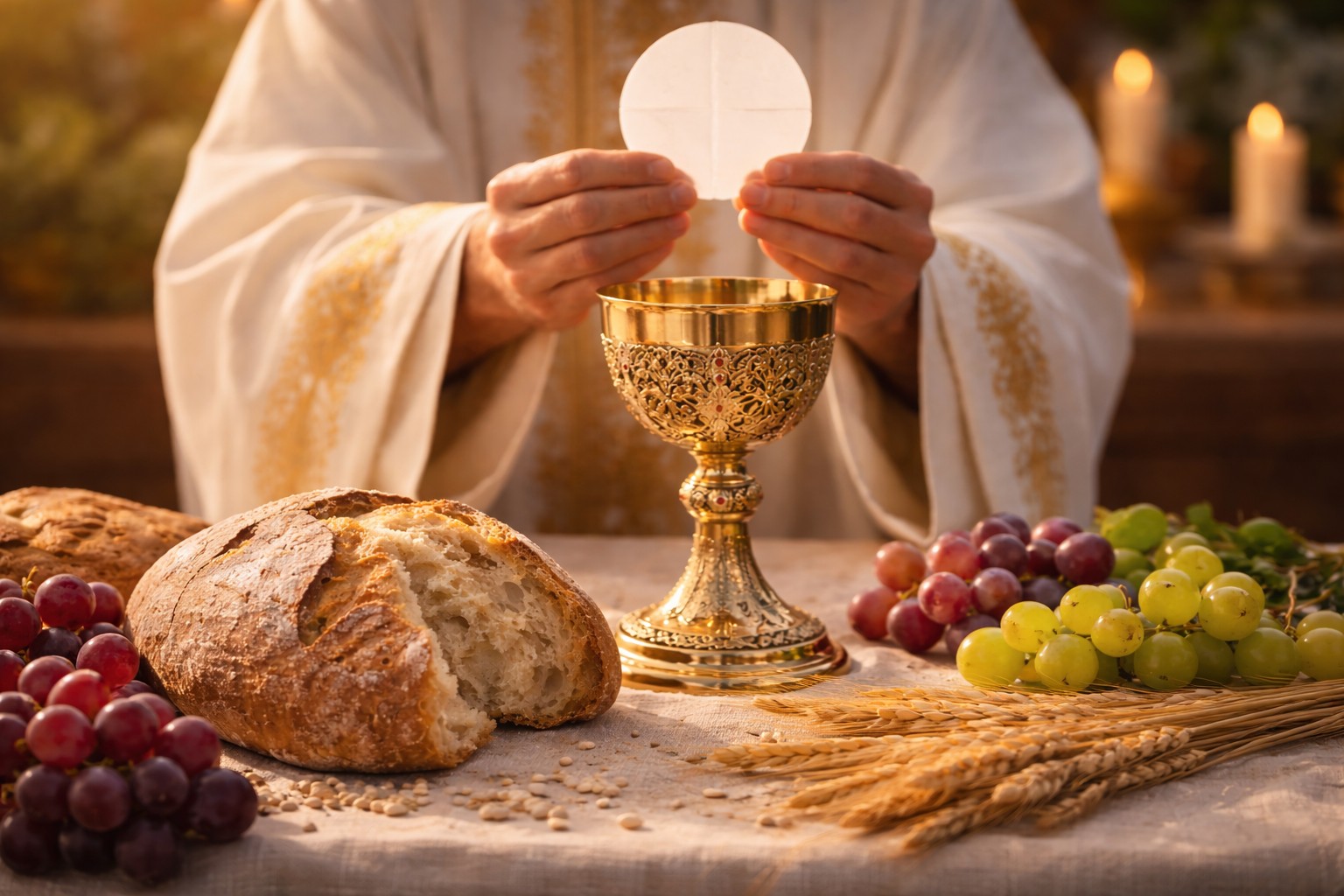
The Eucharist not only keeps alive the memory of what Christ has done by giving his life for us. More profoundly, the Eucharist manifests the ever-present experience of what Christ and the Spirit continue to do for us throughout our lives.
This week’s first reading (Deuteronomy) connects the celebration of the Eucharist to the Exodus event of Israel’s liberation from slavery in Egypt. Again, the Israelites do not just remember what God has done for them in the past – liberating them, and feeding them in the desert with “manna from heaven” – but celebrating the way God continues to be with them throughout all of life’s trials, tribulations, hopes and joys. Everything we have – food, shelter, love, friendship and personal talents – are gifts given to us by God to share with others.
In St Paul’s Letter to the people of Corinth, we are told the gifts of bread and wine are the very body and blood of Christ enabling us to be in communion with the Trinitarian God. Moreover, Paul’s emphasis on “one loaf” means, in the words of the hymn, “we though many are truly one.”
Hence the importance of the sign of peace we offer to one another each time we celebrate the Eucharist. In the gospel, we hear Jesus speak of the “living bread that comes down from heaven.”
Pope Francis told us that “the Eucharist is not a prize for the perfect, but medicine and nourishment for the weak!” In saying this he is not suggesting we should go to the Eucharist without thoughtfulness, prayer and presence of mind; but he is also reminding us that all of us, without exception, come to the Eucharist as sinners in need of God’s healing grace and mercy.
Pope Francis also provides guidelines for how the Eucharist should make a real difference in our lives and relationships with others. First, he says, we need to relate to people, sharing in their joys, hopes, sorrows and sufferings. Furthermore, this should enable us to reach out to the poor, sick and marginalised people, seeing in them the face of Christ.
Second, experiencing God’s forgiveness in the Eucharist should enable us to see ourselves as “forgiven sinners” who are empowered to reach out in forgiveness to others. In this way the Eucharist enables us to overcome pride and division.
Third, the Eucharist should enable us to become active disciples of Jesus Christ. While we Christians do not claim to be better than others, we nonetheless recognise our particular mission is to make Christ known and loved through a spirit of prayer, action and care for all our brothers and sisters, most especially those in need.
In the words of Anglo-Catholic poet TS Eliot, Christ is “the still point of the turning world.” It is especially through our celebration of the Eucharist that our distracted, busy, turning worlds are stilled by the overpowering, silent mystery that camouflages the saving, liberating, loving presence of Christ in the broken bread and sweetened wine.
For He is indeed truly present among us as the very life of the world.
Gerard Hall SM
© Majellan Media 2026
We encourage you to share and use this material on your own website. However, when using materials from Majellan Media, please include the following in your citation: Sourced from www.majellan.media